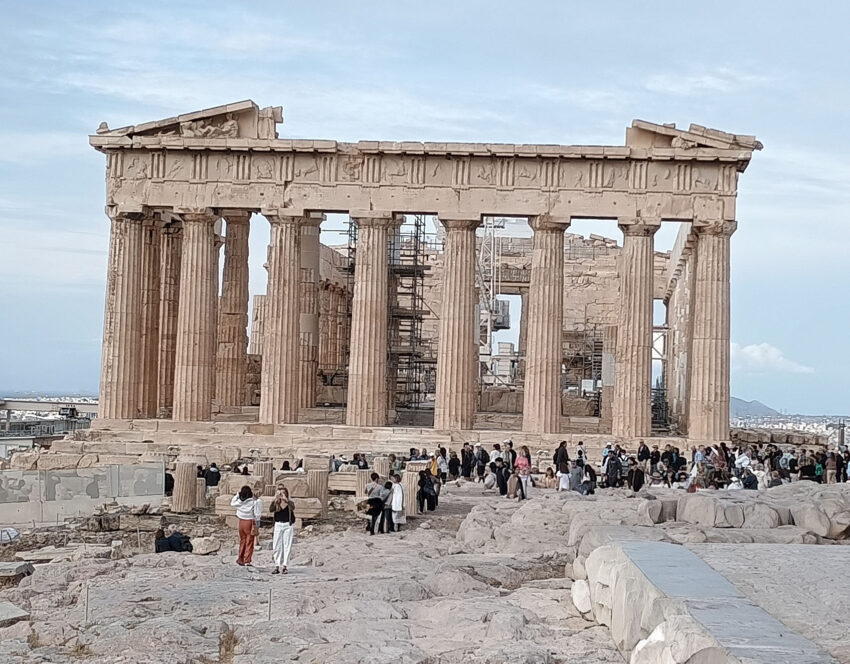
Athens, Greece is a magical place full of history and epic myths.
According to legend, the city’s original name was Cecrops, who was the supposed first king of Athens. Because the city did not have a patron God, Athena, daughter of Zeus, and Poseidon, brother of Zeus, presented gifts to Cecrops. Poseidon struck his trident into the hard rock of the Acropolis (the highest point in Athens) and salt water came rushing out. Athena presented an olive tree. The olive tree represents everything the people need to thrive because it “provided oxygen, food, olive oil, wood, and shadow. The people voted for Athena and renamed the city to Athens. To pacify Poseidon, the people built the temple of Erechtheion to house the spring he created.
The descendent of Athena’s olive tree is thriving at the Acropolis today.
A Ghostly Presence or Not?
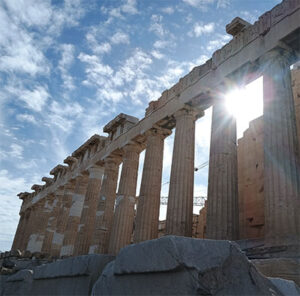 As I stood at the top of Acropolis Hill, I was overwhelmed by the beauty and mystery of this historic place. I must admit, I was awestruck. The stone steps were shiny, slick and worn from all of the people that walked on these centuries-old paths. Oddly, I could not feel ghosts, hear their voices, or “see” the historic events that had taken place over time. Instead, I felt peace. It was the complete opposite of my experience at the coliseum in Rome, where the ghosts of the past were present everywhere.
Why? I wondered.
Perhaps credit needs to go to the cats. In Greece and its 6000+ chain of islands, there are cats everywhere. Some cats are wild. Others are aloof. A few cats just want to be petted.
 There was even a cat at the base of the Parthenon. It rested peacefully – just out of reach of the tourists.
Guardians of the Spirit World
Ancient Greeks believed cats offer protection and good luck and keep evil spirits at bay. Perhaps their presence offers benefits in the modern world too?
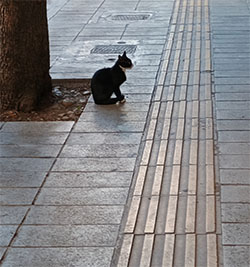 According to Wisdom of the Spirit, cats have a number of spiritual meanings including: symbols of intuition, guardians of the spirit realm, protectors of energy, messengers of mystery, symbols of transformation and rebirth, and more.
“Beyond their role as cuddly companions or internet superstars, cats carry deep spiritual significance in many traditions. From ancient Egypt to modern-day spiritual practices, these enigmatic creatures are often seen as guides, protectors, and symbols of the divine.” – Sophia Rose, Wisdomofthespirit.com
The Prison of Socrates
In 399 BC, famed philosopher Socrates spoke out against the existence of deities, thereby failing to “acknowledge the gods the city acknowledged.” He prompted the youth of that time to consider new deities (moral corruption). He was charged by the government with “asebeia against the pantheon of Athens and corruption of the youth of the city-state.” He could have chosen exile. Socrates could have escaped. Instead, he declared the “unexamined life is not worth living,” and agreed to abide by the laws of Athens. For his crimes, he was jailed near the Acropolis and sentenced to death. Poisonous hemlock sealed his fate.
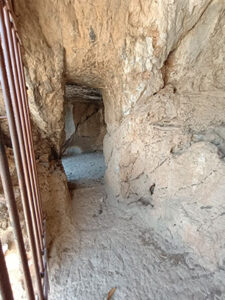 Historians admit they are not certain exactly where Socrates was imprisoned. It was decided the location must be a series of connected caverns near the Acropolis. Out of curiosity, I visited the “Prison of Socrates.” I touched the exterior walls and felt sadness. I did not feel the presence of Socrates there. It sounded like the walls were whispering. Perhaps it was the echo of water running below the surface, or something more?
The feeling of sadness may have been in response to the use of the place more recently. During World War II, the people of Athens hid the antiquities of the Acropolis and the National Archaeological Museum there. Once the treasures were tucked away, the place was sealed in concrete to avoid discovery.
Transportation in Style: A Ghost on the Plane
My experience in Greece and the island of Crete was both peaceful and enlightening. That was not the case on a plane ride between the two places!
 On a short flight between Crete and Athens, I could feel a strong presence around me. It was teenage boy. Two seats to my right, I watched the tray table drop down on its own. The hair stood up on my arms and neck. Cool breezes blew around my feet, legs and across my arms. I heard the word “Pat!” yelled in my left ear. It was not a warning. The ghost was not in distress. He was having fun. I smiled in acknowledgement. Perhaps he wanted a shorter way to travel from Crete to Athens? Or maybe it’s because there were no cats on the plane?
Looking for Guidance in Your Life?
If you are looking for clarity, have a question, or you would like to know what is ahead for you in your life, reach out and connect with PsychicLifeAdvice.com on the contact page. I look forward to hearing from you!